
Serengeti National Park
Tanzania's endless plains, where the Great Migration circles year-round and the Seronera valley holds lion, leopard and cheetah.
Wildlife species
Works offline
Languages
Offline maps
Inside the Serengeti National Park app
A dedicated app for just this park — a complete offline wildlife guide, maps and ranger tips, built to work deep in the park where there is no signal. Download it before you go and use it the whole trip.
498 animals
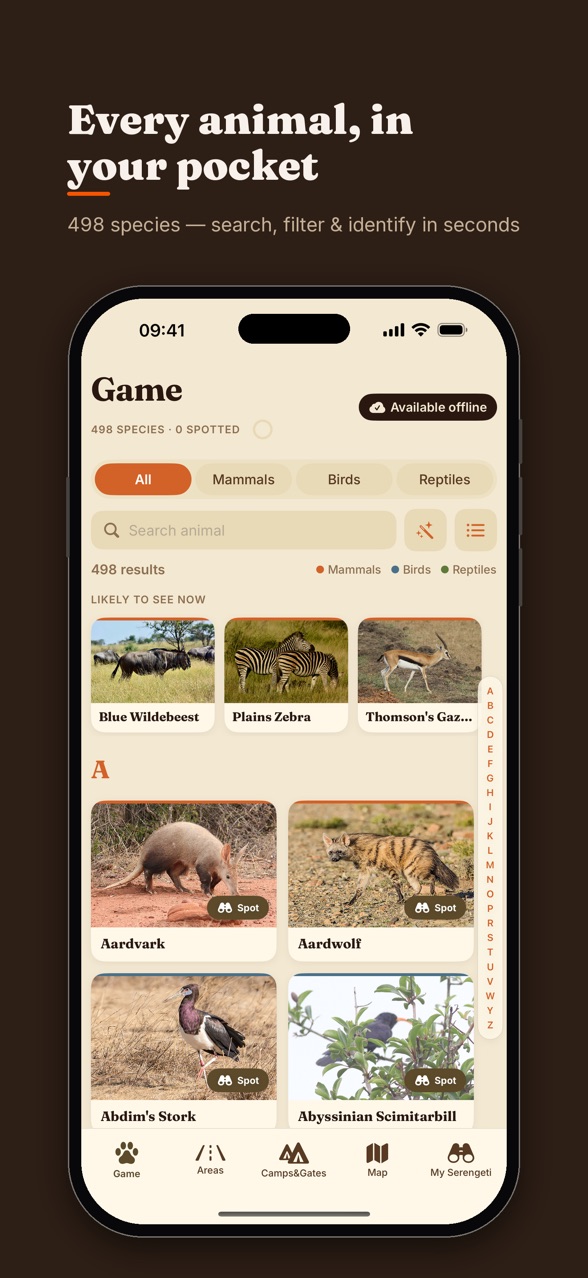
A full illustrated wildlife guide with photos, calls and field facts for the species you will actually see here.
Works with no signal
The guide, maps and your sightings all work completely offline — download once before you set off.
Offline GPS maps
See exactly where you are and navigate the park confidently, even where there is no mobile network at all.
Self-drive routes
The best drives and loops for this park, plus gate times and camp information to plan each day.
Track your safari
Log every sighting and build your own species list — see how many animals you have spotted over the years.
8 languages
Available in English, Dutch, German, French, Italian, Brazilian Portuguese and more.
The Big Five
Meet the Big Five
Plus every bird and reptile in the park — 498 species in all — each with photos and field notes, so you know exactly what you are looking at.
Big Five
Lion
Africa’s largest lion population — scan the central kopjes.
Big Five
Leopard
The Seronera river forest is one of Africa’s most reliable leopard haunts.
Big Five
Elephant
Herds favour the northern woodlands and river lines.
Rare
Black rhino
A small population survives around the Moru Kopjes — strictly protected.
Big Five
Buffalo
Big herds in the woodlands — while a million wildebeest steal the show.
Plan your visit
Know before you go
Best time
By region
February for calving in the south; July–August for river crossings in the north.
Getting there
Fly or drive
Reachable by a scenic self-drive or a short regional flight from the nearest hub.
Health
Malaria area
Prophylaxis is recommended — visit a travel clinic before you fly.
Self-drive
Gates & times
Gates open at sunrise and close at sunset sharp; plan your loop around them.
“I have driven these parks for years and still open the app at every junction — knowing which road leads to which waterhole, and logging every sighting, completely changed how we travel.”
A Safari Guy regular
In short — Serengeti map
- 7 named routes, each rated separately.
- 6 entrances: Bologonjar Gate, Klein’s Gate and Naabi Hill Gate (+3).
- 14 camps and lodges inside the park, 14 with a shop.
- Best route for wildlife: Far North — wildebeest, Nile crocodile and leopard.
Serengeti map: the roads, gates and camps
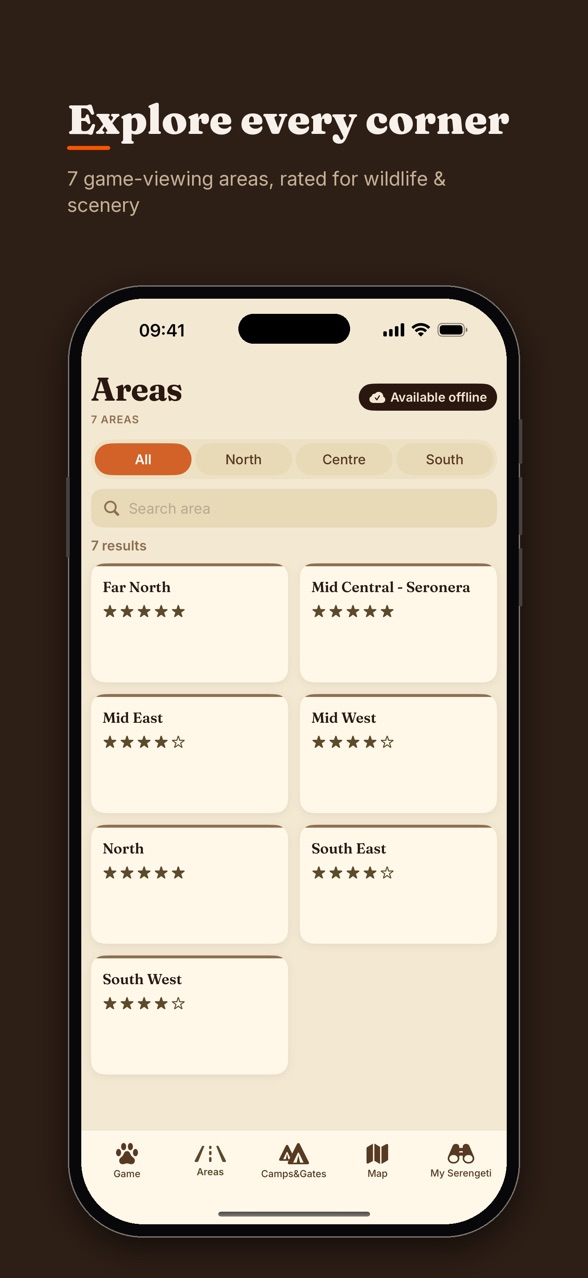
Seven named driving routes run through Serengeti, and our map rates each one separately.
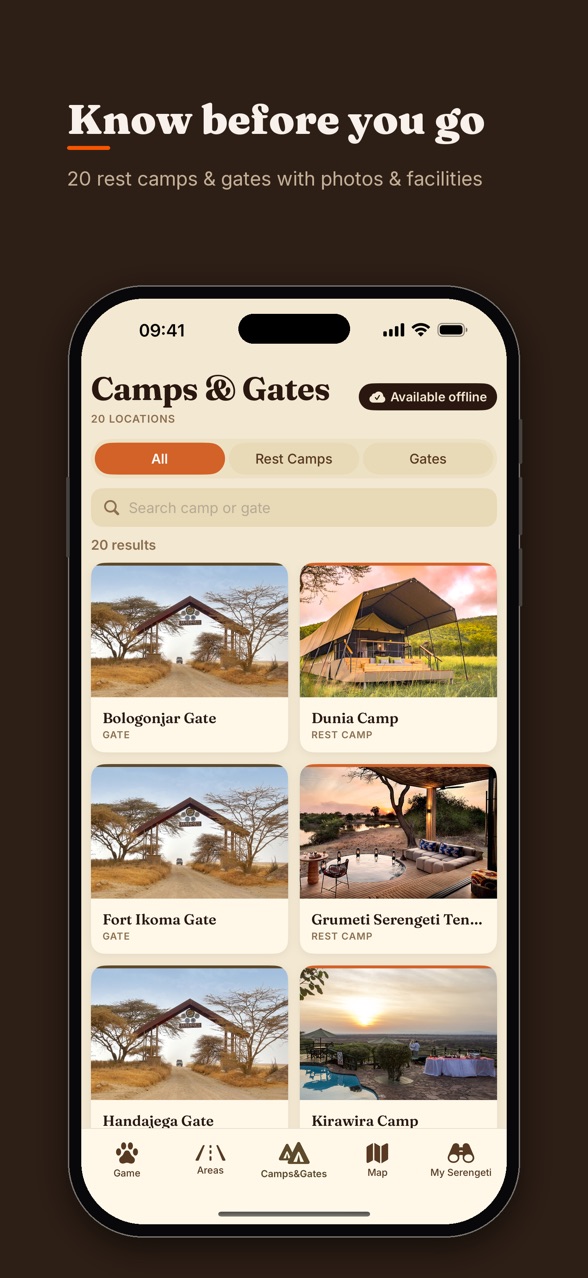
Six entrances let you in: Bologonjar Gate, Klein’s Gate, Naabi Hill Gate, Ndabaka Gate, Fort Ikoma Gate and Handajega Gate. Which one you use decides your first hour, because the distance from each gate to the best early roads is not the same.
Inside there are fourteen camps and lodges, among them Serengeti Bushtops, Serengeti Migration Camp, Lobo Lodge, Seronera Lodge, Serengeti Serena, Kirawira Camp, Mbuzi Mawe Tented Camp and Namiri Plains Camp. Of those, every one has a shop.
The animals our road data flags most often here are leopard, wildebeest, Nile crocodile, lion and elephant. Far North carries the highest wildlife rating of any route in the park, for wildebeest, Nile crocodile, leopard and tsessebe.
What the paper map at the gate will not tell you is which of those seven routes is worth your morning. Our offline map rates every road separately for mammals, birds and landscape, and names the species recorded along it. It keeps working where there is no signal, which across Serengeti is most of it.
The name Serengeti comes from the Maasai “siringet” — endless plains. It fits. The southern Serengeti is a sea of short grass that stretches to the horizon, dotted with kopjes and acacias. The north is hillier, with the famous Mara River that the migration crosses twice a year.
Timing is everything. December–March is calving season in the south — half a million wildebeest calves born in three weeks, predators on full alert. June–August the herds move north and ford the Mara River. October–November they return south.
Outside migration season the resident wildlife alone makes the Serengeti world-class: enormous lion prides on the central kopjes, cheetah on the plains, leopard in the Seronera river forest. Black rhino is rare but possible in the Moru region.
The offline app
Inside the Serengeti National Park app
Your offline companion for Serengeti National Park — everything below keeps working with no phone signal, once you’ve downloaded the park.
- Offline maps & live GPS — detailed maps with your position, camps, gates, picnic spots and points of interest.
- 7 roads, each with an in-depth guide to the landscape and wildlife along the way.
- 14 rest camps & campsites — facilities, tips and what to expect at each.
- Wildlife encyclopedia — 498 species of mammal, bird and reptile, with photos, ID tips and where to find them.
- Safari logger — record every sighting with species, location and time.
- Achievements & insights — earn badges and track your own safari stats.
- Available in 8 languages — English, Afrikaans, French, German, Spanish, Dutch, Portuguese and Italian.
See it in action

Subscriptions
Made for how you travel
Every subscription unlocks the offline maps, the full road & camp guides, the wildlife encyclopedia and the safari logger. Take a single park for the length of your trip, or the whole of Africa:
- Weekly — perfect for a one-off trip, when the safari is part of a bigger holiday.
- Monthly — for the enthusiasts who get into the parks regularly.
- Yearly — for the true safari fanatics, and the best value at under €2 / $2 per month.
- Africa subscription — monthly or yearly, and it unlocks every park we cover in Africa, from Kruger to the Serengeti.
🔒 Your sightings are yours to keep. Everything you log stays on your device and remains available even if your subscription ends.
Camps and lodges
Serengeti Bushtops · Serengeti Migration Camp · Lobo Lodge · Seronera Lodge · Serengeti Serena · Kirawira Camp · Mbuzi Mawe Tented Camp · Namiri Plains Camp · Dunia Camp · Grumeti Serengeti Tented Camp · Sayari Camp · Lamai Serengeti · Pioneer Camp · Kusini Camp
Plan your trip
Frequently asked questions
Where do the Mara River crossings happen in the Serengeti?
In the far northern Serengeti, along the Mara River on the Kenyan border, roughly between July and October. The herds move back south through the Seronera area from November, and calve on the southern short-grass plains around February.
Is the Serengeti worth visiting outside migration season?
Yes. The Seronera valley in the centre holds resident lion, leopard and cheetah all year, and the southern plains in the green season are quieter, cheaper and full of newborn animals. The migration is a spectacle, not the whole park.
How many species does the Serengeti hold?
Our Serengeti guide covers 498 species of mammal, bird and reptile — the richest of any park we map, ahead of both Kruger and the Masai Mara.
Where can you stay inside the Serengeti?
There are 14 camps and lodges inside the park, from permanent lodges such as Seronera and Lobo to mobile tented camps like Sayari and Namiri Plains that move with the migration.


