
Etosha National Park
Built around a salt pan visible from space, where Namibia's wildlife gathers at floodlit waterholes and black rhino are the draw.
Wildlife species
Works offline
Languages
Offline maps
Inside the Etosha National Park app
A dedicated app for just this park — a complete offline wildlife guide, maps and ranger tips, built to work deep in the park where there is no signal. Download it before you go and use it the whole trip.
426 animals
A full illustrated wildlife guide with photos, calls and field facts for the species you will actually see here.
Works with no signal
The guide, maps and your sightings all work completely offline — download once before you set off.
Offline GPS maps
See exactly where you are and navigate the park confidently, even where there is no mobile network at all.
Self-drive routes
The best drives and loops for this park, plus gate times and camp information to plan each day.
Track your safari
Log every sighting and build your own species list — see how many animals you have spotted over the years.
8 languages
Available in English, Dutch, German, French, Italian, Brazilian Portuguese and more.
Wildlife highlights
Meet Etosha’s specialists
Plus every bird and reptile in the park — 426 species in all — each with photos and field notes, so you know exactly what you are looking at.
Icon
Elephant
Dust-white giants — big bulls dominate the waterholes.
Rare
Black rhino
One of Africa’s best places to see them — watch the floodlit waterholes after dark.
Highlight
Lion
Dry-season ambushes at the waterholes; listen at dusk.
Highlight
Giraffe
The classic silhouette against the great white pan.
Highlight
Cheetah
Short grass and open plains suit Africa’s fastest cat.
Plan your visit
Know before you go
Best time
May–Oct
Dry season: park at a waterhole and let the game come to you.
Getting there
Fly or drive
Reachable by a scenic self-drive or a short regional flight from the nearest hub.
Health
Seasonal risk
Low-risk and mainly in the wet season — ask your doctor.
Self-drive
Gates & times
Gates open at sunrise and close at sunset sharp; plan your loop around them.
“I have driven these parks for years and still open the app at every junction — knowing which road leads to which waterhole, and logging every sighting, completely changed how we travel.”
A Safari Guy regular
In short — Etosha map
- 928 km of road across 41 named routes, 2 of them tarred.
- 4 entrances: Andersson’s Gate, Von Lindequist Gate and Galton Gate (+1).
- 6 camps and lodges inside the park, 6 with a shop.
- Best route for wildlife: Okaukuejo to Rietfontein — lion, black rhino and zebra.
Etosha map: the roads, gates and camps
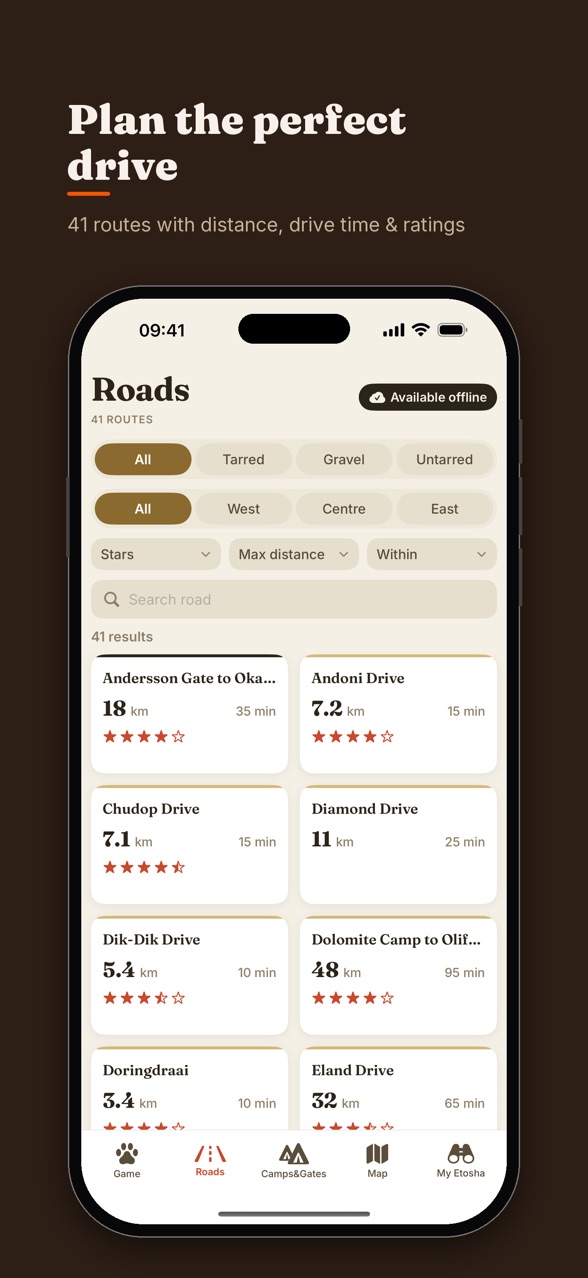
Forty-one named routes make up the 928 km of game-viewing road inside Etosha. Tar covers 29 km of that, spread over two routes; the remaining thirty-nine are gravel.
Four entrances let you in: Andersson’s Gate, Von Lindequist Gate, Galton Gate and King Nehale Lya Mpingana Gate. Which one you use decides your first hour, because the distance from each gate to the best early roads is not the same.
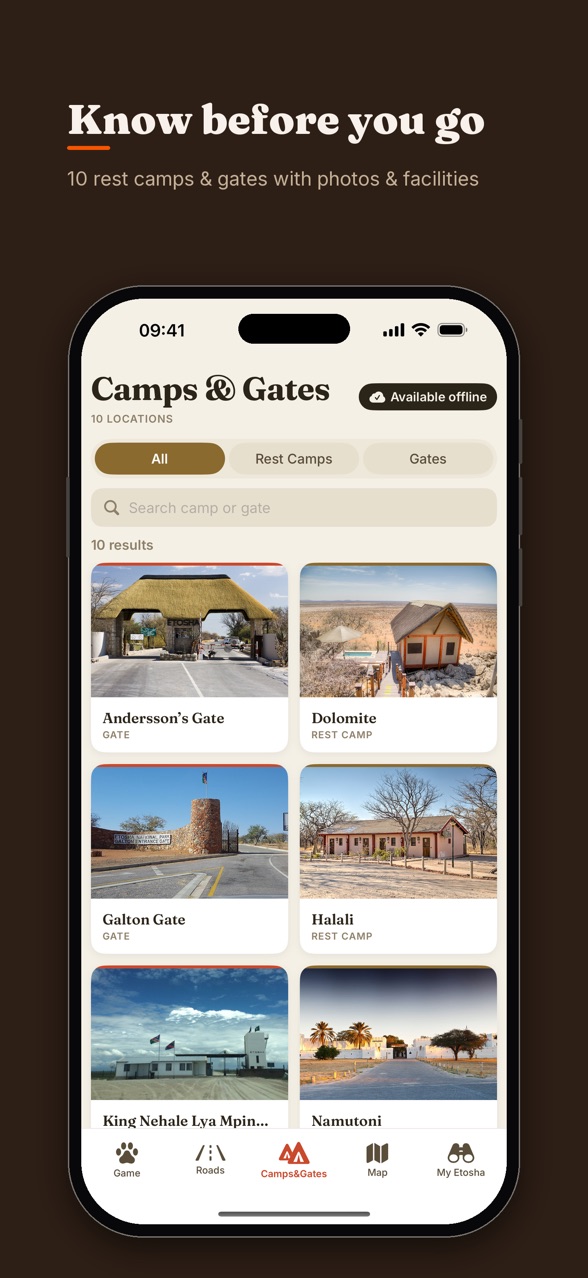
Inside there are six camps and lodges: Okaukuejo, Halali, Namutoni, Dolomite, Onkoshi and Olifantsrus. Of those, every one has a shop, five sell fuel and four take campers. There are also eight picnic sites where you may legally leave the vehicle.
The animals our road data flags most often here are elephant, lion, springbok, giraffe and zebra. Okaukuejo to Rietfontein carries the highest wildlife rating of any route in the park over its 51.6 km, for lion, black rhino, zebra and elephant.
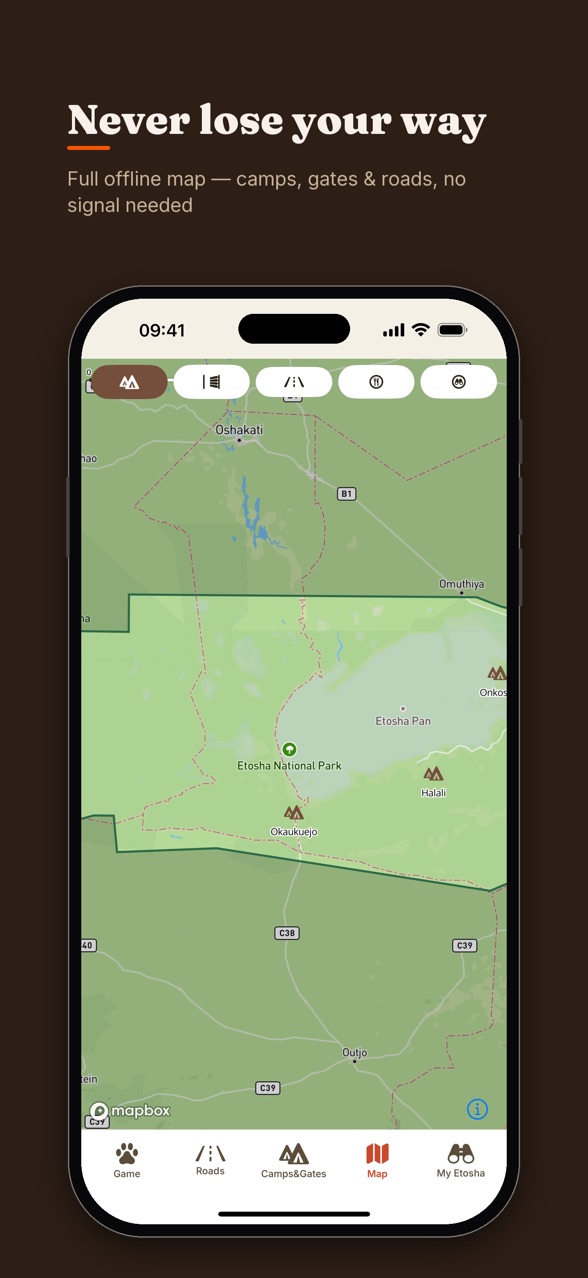
What the paper map at the gate will not tell you is which of those forty-one routes is worth your morning. Our offline map rates every road separately for mammals, birds and landscape, and names the species recorded along it, alongside fifty-eight marked sights. It keeps working where there is no signal, which across Etosha is most of it.
Etosha is unlike any other African park. The white salt pan dominates the landscape — a 4,800 km² shimmering crater visible from space. The park grew around it, dotted with permanent and seasonal water holes that act as wildlife magnets in the dry season.
What makes Etosha special is the visibility. The sparse vegetation and reflective pan mean you can see for kilometres. Predators have nowhere to hide. Black rhino sightings are excellent here — some of the best in Africa. Lions, leopards, cheetahs, elephants and giraffes are all on the menu, plus large herds of springbok, oryx and zebra.
Most camps have floodlit water holes where you can watch animals come and go after dark — a unique Etosha experience that no other park offers at this scale.
The offline app
Inside the Etosha National Park app
Your offline companion for Etosha National Park — everything below keeps working with no phone signal, once you’ve downloaded the park.
- Offline maps & live GPS — detailed maps with your position, camps, gates, picnic spots and points of interest.
- 41 roads, each with an in-depth guide to the landscape and wildlife along the way.
- 6 rest camps & campsites — facilities, tips and what to expect at each.
- Wildlife encyclopedia — 426 species of mammal, bird and reptile, with photos, ID tips and where to find them.
- Safari logger — record every sighting with species, location and time.
- Achievements & insights — earn badges and track your own safari stats.
- Available in 8 languages — English, Afrikaans, French, German, Spanish, Dutch, Portuguese and Italian.
See it in action

Subscriptions
Made for how you travel
Every subscription unlocks the offline maps, the full road & camp guides, the wildlife encyclopedia and the safari logger. Take a single park for the length of your trip, or the whole of Africa:
- Weekly — perfect for a one-off trip, when the safari is part of a bigger holiday.
- Monthly — for the enthusiasts who get into the parks regularly.
- Yearly — for the true safari fanatics, and the best value at under €2 / $2 per month.
- Africa subscription — monthly or yearly, and it unlocks every park we cover in Africa, from Kruger to the Serengeti.
🔒 Your sightings are yours to keep. Everything you log stays on your device and remains available even if your subscription ends.
Camps and lodges
Okaukuejo · Halali · Namutoni · Dolomite · Onkoshi · Olifantsrus
Plan your trip
Frequently asked questions
Which Etosha waterhole should you sit at?
Okaukuejo is the famous one — floodlit, and the best black rhino viewing in Africa after dark. Halali’s Moringa hide is quieter and often better for leopard, and Namutoni gives you the eastern pan. Fifty-eight waterholes and viewpoints are mapped in total.
What is the Etosha Pan?
A salt pan of roughly 4,800 km² at the heart of the park — the dried bed of an ancient lake, visible from space, and dry for almost the whole year. Game concentrates on its fringes, where the springs are.
Is there buffalo in Etosha?
No. Etosha has lion, leopard, elephant and both black and white rhino, but no buffalo, so it falls one species short of the Big Five. Black rhino is the one to come for: Etosha holds the largest population in the world.
Where can you stay in Etosha?
Six camps: Okaukuejo, Halali and Namutoni on the main road, Dolomite in the far west, Onkoshi on the pan edge, and Olifantsrus, which is camping only and has the park’s best walk-in hide.


